Off the caffeine again

Remember my love-hate relationship with coffee? I decided to become a caffeine underachiever again and stick with decaf after I read how caffeine greatly inhibits REM sleep stages. Being a lucid dreamer (or at least, trying to be), I value REM sleep because thats where lucid dreaming takes place.

It’s not as if I’ve had lots of caffeine lately. About 1/3 of the coffee beans I had been grinding have been caffeinated. Even that little amount provided a strong addiction, enough so that when I cut it down to about 1/10th this week I had a few days of unpleasant headaches. By the third morning, though, I was fine without it.
Continue reading


About those solar panels

Raleigh's going solar

I spent some time Friday at a dedication ceremony for the City of Raleigh Parks Department’s new greenhouse. One might think that a greenhouse wouldn’t be exciting but this is no ordinary greenhouse. It’s got energy-efficient features, it’s fully automated, and for the first time it provides the City the ability to grow any type of plant during any season. Raleigh’s parks, streets, and highways look so sharp because of the work of the Parks and Recreation Department’s horticulture and landscaping teams, who keep Raleigh looking beautiful through the careful stewardship of our trees, plants, and flowers.
Continue reading

Neutrino particle traveling faster than light?

Every now and then, a scientific discovery delivers to us smug mortals a healthy kick in the head: reminding us that for all our bravado we still don’t know squat about how the universe really works!

Neutrino particle traveling faster than light? Two ways it could rewrite physics.

European scientists are shocked by an experiment that showed neutrino particles moving faster than light. The result, if confirmed, could challenge Einstein’s signature theory on relativity or point to a universe of more than four dimensions.

via Neutrino particle traveling faster than light? Two ways it could rewrite physics. – CSMonitor.com.

Smartphones and the world around them

Smart phones should not be new to me. Though I haven’t owned one until a few weeks ago when we bought LG Optimus V phones, I have of course been around them since the first iPhone came out. I would’ve thought that I would be well-familiar with them now but one insight into smartphones really surprised me.

Up until the smartphone, computers were by and large completely ignorant of their surroundings. For instance, old-school computers would not have noticed any effects at all during our recent 5.9-magnitude Virginia earthquake, but a smartphone could’ve! Smartphones can detect movement and motion and direction and position and orientation: a myriad of physical-space properties which were completely alien to most computers not very long ago. Some ambitious geek could write herself an app which aggregates the accelerometer readings of thousands of smartphones and uses that data to detect and pinpoint earthquakes, for instance. This is what fascinates me about my new smartphone: the potential it offers for physical-space interaction.
Continue reading

San Diego blackout

Hassayampa switchyard

One of my enduring memories of visiting Subic Bay Naval Base in the Philippines twenty years ago was passing by the base’s power plant. There was row after row of semi-truck-size 250kw diesel generators, all roaring away and belching unfiltered black smoke into the thick tropical air. The civilian power source frequently suffered brownouts so the base had to generate its own electricity.

I never thought that Naval Base San Diego would suffer the same conditions, but yesterday millions of San Diego residents lost power when a problem at a switching station in Arizona sent the San Diego County’s electrical grid crashing down within minutes. Being an electricity geek with a fascination for electrical malfunctions, I had to find out more about this situation.

According to the Arizona Public Service press release:
Continue reading

Ways to solve our political mess

I’ve been pondering the crazy state we find ourselves regarding politics in this country. Getting elected today (particularly to a national office but local ones as well) comes down to two things:

1. Raising gobs of money
2. Getting your message out.

This tends to get politicians chasing the big donors (i.e. large corporations when aiming for Congress or higher) when they really should be responsive to their constituents instead. Lately we’ve seen how that’s working out, aren’t we?

It’s obvious that we need to do something about the money. So, why are gobs of money needed? To accomplish goal #2: to get your message out. Buying broadcast time is hugely expensive but it’s the quickest way of reaching voters. What if candidates didn’t have to raise money for broadcast time, though? What if air time was made freely available in the name of patriotism?
Continue reading

Cheap thoughts: illumination

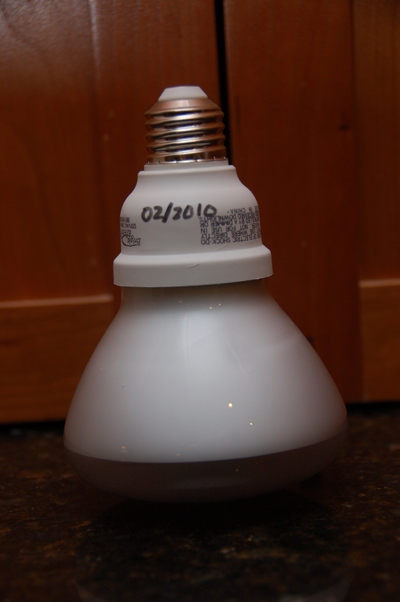
Dead CFL bulb


I began labeling my CFL bulbs with the date I put them into service. This one died today after just 18 months of use. Ordinary bulbs last far longer than this! Cheap (possibly counterfeit) electronics are to blame.

So if CFLs aren’t the answer, what is? When will LED bulbs be ready for prime time? Is there a future where we move beyond bulbs entirely? Are self-illuminated walls and ceilings in our future?

Americans saving more, spending less

I read this Associated Press story with interest Tuesday. It announces “troubling signs” for the economy.

WASHINGTON — Americans cut their spending in June for the first time in nearly two years after seeing their incomes grow by the smallest amount in nine months. The latest data offered a troubling sign for an economy that is adding few jobs and barely growing.

So, what are the “troubling signs (emphasis mine)?”

Consumer spending dropped 0.2 percent in June, the Commerce Department said Tuesday. It was the first decline since September 2009.

… and …

Incomes rose 0.1 percent, the smallest gain since September. Many people are also pocketing more of their paychecks. The personal savings rate rose to 5.4 percent of after-tax incomes, the highest level since August 2010.

So if the cloud is the state of our abysmal economy, the silver lining is that Americans are getting their own financial houses in order.

Roku magic

Roku

A week ago, I decided to dust off our Roku player. It had been spending most of its time umplugged because it competed for the only S-Video jack on our bedroom’s old TV. The Roku can kick out a 720p HD picture, though, and our HDTV has a ton of unused inputs so I ordered a new HDMI cable and hooked it up once it arrived. The Roku looks beautiful on the HDTV.

Yesterday, Netflix announced the company is hiking its prices by up to 60%. While I’m disappointed by Netflix’s move (and think BitTorrent traffic will undoubtedly rise as a result), having the Roku available means I have plenty other choices for Internet TV. Not only does the Roku play Netflix’s streaming, it carries dozens and dozens of other channels, both video and music.

Tonight I used a handy Javascript page to load up the Internet radio station I’ve been building so that it plays on my Roku’s Shoutcast channel. The Roku streams online radio stations very, very well. I like being able to fire up a station on the Roku, turn off the TV, and listen to the station on the stereo. Beats having a full-size computer doing it.

I’ll continue to tinker with the Roku. I’ve been pretty impressed with what it can do.

Space shuttle

This morning at 11:26 AM, space shuttle Atlantis may or may not make its final flight into space. This will be the last mission of NASA’s shuttle program.

I remember watching on TV as space shuttle Columbia made the very first shuttle launch back in 1981. Of course, I also saw a few rocket launches for things like Skylab and space probes like Voyager, but the shuttle program was different. It was touted as essentially a space bus: making spaceflight routine with a reusable vehicle.

It didn’t turn out that way, as the reusable aspect of the shuttle made it incredibly expensive. Shuttles turned out not to be as reliable as they were initially touted. I remember being in my high school’s library, watching video of Challenger exploding as my math teacher sat nearby, weeping. It was a cruel reminder that nothing about riding rockets would ever be routine. The flagship shuttle, Columbia, proved that when it disintegrated above Texas during landing in 2003.

If all goes well, Atlantis will make a safe trip to the International Space Station (ISS) and then roll its way into a museum. With it, a space program stretching into the early 1970s will come to an end. I’m not sure what comes next for American space exploration but I hope it continues in one shape or another.