N&O online site to switch to paywall

McClatchy announced that will soon be locking up its content behind a paywall, including the News and Observer’s website:

The company also announced that it would install metered pay walls at its newspaper websites, including NewsObserver.com. It did not disclose specifics of the plan, which will begin later this year, but in general readers will get certain number of page views free each month before being required to pay a subscription.

I’ve never thought paywalls were a good idea. Opinions differ about their effectiveness. Poyntner says 52% of media professionals leave a website when encountering a paywall. Other newspapers’ efforts to establish a paywall resulted in the opposite of their intended effect:
Continue reading
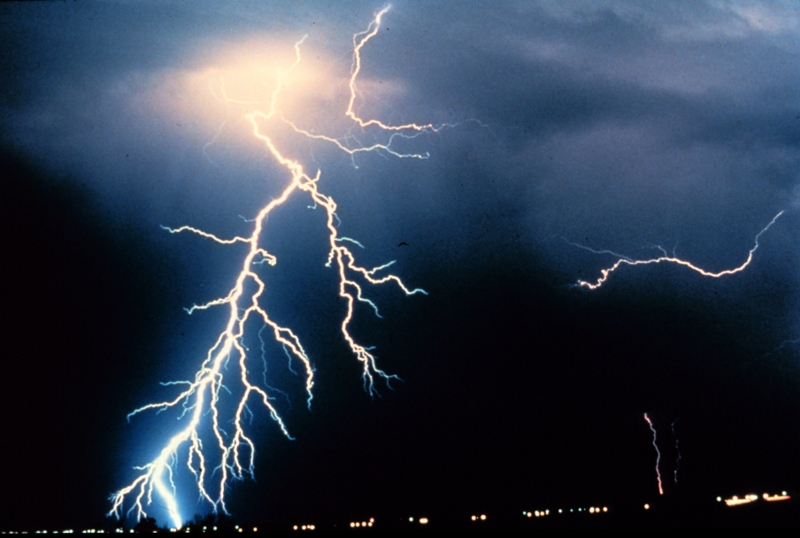
Lightning and nuclear reactions

We had a few close bolts of lightning during last evening’s thunderstorm. One of the bolts caught fire to a neighbor’s backyard shed. It was one of the scarier lightning storms I’ve experienced.

I decided to look up some info on lightning today and came across this PBS page written by a lighting expert. Dr. David Dwyer, Associate Professor of Physics and Space Sciences at Florida Institute of Technology, answers questions about lightning. I found this Q&A particularly intriguging.

Q: Within the NOVA Web site I read that lightning heats the surrounding air of a lightning bolt to ~50,000°F, or hotter than the sun. The sun, as I understand it, generates heat through fusion reactions. So why don’t we see fusion reactions taking place within the surrounding air of a bolt of lightning? Casey, La Jolla, California

The surface of the sun is about 10,000°F, which is much cooler than the hottest part of lightning. However, the nuclear fusion that powers the sun occurs only near the center where the temperatures are much higher (30 million°F) and the pressures are very large. In comparison, lightning is downright chilly. As a result, no nuclear reactions are expected to take place during lightning. Having said all this, several independent research groups have recently measured nuclear by-products associated with lightning, which according to our standard picture doesn’t seem possible. If these results are correct, then something very unusual is happening with lightning—so stay tuned.

I did more poking around and found some articles of studies that seem to show that lightning can produce gamma rays. Those bolts may also be hurling antimatter into space! Fascinating!

via NOVA | Lightning: Expert Q&A.

KVM upheaval continues

Back in May, I got an unsolicited email from a consulting firm who had been hired by the main competitor of a company I used to work for in “the KVM space,” as business dweebs like to say. The consultant had been hired to “understand the current KVM market” and my post from 2007 predicting the death of KVM had caught his eye. The consultant wanted to pick my brain about the post and whether I had any other insights to share.

Being that he was working on behalf of a former competitor, initially I was reluctant to respond. I blame that competitor’s long-running lawsuit against my former employer for me getting laid off from the best job I ever had. Eventually, though, I decided to chat for a bit as it had been 5 years since I had written that and five years since I’d worked for that company.

I didn’t have much more to add to what I had written in 2007. I have worked in large datacenters in the meantime and my prediction has held up in every instance. The KVM market is dying if not already dead.

Earlier this week I received news that one of the employees I hired at my former employer just lost his job. While I don’t know all the details I have to wonder if that shrinking KVM market is to blame. Sad.

Cheap thoughts: digitally-signed images

Why aren’t cryptographic signatures wrapped around digital images in order to bolster their authenticity? Such a scheme would be strong proof that an image taken with a digital camera did in fact originate from that digital camera. Thus, if someone claims to have photographed E.T., we could at least say that the image hadn’t been digitally altered.

This would also be useful for protection against phishing. A image’s signature could include the website an image is supposed to be viewed from. Any scammer including a logo from the FBI in their email would raise flags in the recipients’ email client, which would compare the image’s source to the source encoded in the signature. If the FBI logo was intended to be served from www.fbi.gov, the email client could immediately warn the recipient that something funny is going on.

Yes, there would be ways around it but faking a legitimate image would be challenging. A scammer could always design his own, unsigned image or remove the signature through a screen capture. However, without the FBI’s cryptographic key being used to sign the image, the scammer could not fake the image’s signature as being from the FBI’s website.

It wouldn’t be a perfect solution to prevent fraud but it would be an important tool to prove a digital image’s validity.

Worlds apart

I was pondering how this weekend’s freak storm knocked power out for over a million people, leaving them temporarily without the comforts of the modern world. I thought about how it’s now 100° outside yet I’m comfortable in my air-conditioned home. I’ve got a refrigerator full of fresh fruit, a comfortable bed, and more fresh water than I know what to do with.

The I thought about Liberia and how less than 1% has electricity. Water is also scarce. Compared to those poor souls, I live like an absolute king. So do 99.9% of Americans.

We are extraordinarily blessed to live in this country. In the grand scheme of things, the things Americans complain about are really insignificant by comparison.

Shaffer: How much does your soul weigh?

The N&O’s Josh Shaffer takes a look at the upcoming experiments at the Rhine Center in Durham, attempting to weigh the soul. Shaffer calls it an “oddball” branch of science, but I prefer to call it “offbeat,” myself. It is science and no one knows what the experiments will find until they’ve been tried.

I look forward to the results!

DURHAM — For at least 100 years, the more oddball branches of science have struggled to answer this metaphysical head-scratcher: How much does the human soul weigh?

In 1907, a Massachusetts doctor named Duncan MacDougall settled on the figure of 21 grams – the average weight loss experienced by six terminal tuberculosis patients he strapped to a scale at the moment of death.

A dozen years ago, an Oregon rancher named Lew Hollander tried to measure the souls of one ram, seven ewes, three lambs and a goat. His findings: The animals actually gained weight as they shook off this mortal coil – anywhere from 18 to 780 grams.

Now this summer, the Rhine Research Center in Durham will host the latest experiment aimed at nailing down the intangible essence of mankind.

The method: 1.) Stand on a scale. 2.) Have an out-of-body experience. 3.) Record weight.

via Shaffer: How much does your soul weigh? – Shaffer – NewsObserver.com.

Scientists crack RSA SecurID 800 tokens

Remember when I said we are living in a world without secrets? The security tokens that provide two-factor authentication for a number of companies and organizations have been broken. Instantly, countless confidential files became unprotected.

In the age of globally-distributed mathematic expertise, high-speed computers, and Internet collaboration, codes and ciphers that once looked impenetrable now fall on a weekly basis.

Scientists have devised an attack that takes only minutes to steal the sensitive cryptographic keys stored on a raft of hardened security devices that corporations and government organizations use to access networks, encrypt hard drives, and digitally sign e-mails.

The exploit, described in a paper to be presented at the CRYPTO 2012 conference in August, requires just 13 minutes to extract a secret key from RSA’s SecurID 800, which company marketers hold out as a secure way for employees to store credentials needed to access confidential virtual private networks, corporate domains, and other sensitive environments. The attack also works against other widely used devices, including the electronic identification cards the government of Estonia requires all citizens 15 years or older to carry, as well as tokens made by a variety of other companies.

via Scientists crack RSA SecurID 800 tokens, steal cryptographic keys | Ars Technica.

Cheap Thoughts: Solar roads

How long do you think it will be before someone invents a way to easily coat roads with photovoltaic cells so that they generate electricity? Think of how much power that would generate!

Roads and silicon cells are both made of sand, so why not combine them?

A world without secrets

I felt compelled to read up on a recent email thread on the Triangle Linux User Group list that discussed the recent LinkedIn password fiasco. While the discussion didn’t really tell me anything I didn’t already know, it did get me thinking.

I decided that LinkedIn could be cut some slack for their outdated notions of what constituted password security, because the truth is that 99.9% of us also hold outdated notions of password security. That is, the vast majority of us still believe in password security when in fact there is no such thing!
Continue reading