
With this week’s judicial ruling that significantly weakened Net Neutrality, I am more motivated than ever to brush off my now-ten-year-old idea of a cooperative ISP.
Futurist
There are 396 posts filed in Futurist (this is page 20 of 40).
Cord Cutters And The Death Of TV – Business Insider
The cord-cutting and shift away from TV that I mentioned before is accelerating. TV as we’ve known it is dying.
The TV business is having its worst year ever.Audience ratings have collapsed: Aside from a brief respite during the Olympics, there has been only negative ratings growth on broadcast and cable TV since September 2011, according to Citi Research.
Media stock analysts Craig Moffett and Michael Nathanson recently noted, “The pay-TV industry has reported its worst 12-month stretch ever.” All the major TV providers lost a collective 113,000 subscribers in Q3 2013. That doesn’t sound like a huge deal — but it includes internet subscribers, too.
Broadband internet was supposed to benefit from the end of cable TV, but it hasn’t.
In all, about 5 million people ended their cable and broadband subs between the beginning of 2010 and the end of this year.
After loss of key doctors, WakeMed seeks to stabilize
I enjoyed John Murawski’s excellent health care story in today’s N&O. You should read it if you haven’t already.
One underlying theme I deduced from the story is summarized here:
“Hospitals have a possibility of providing you with a network of referring physicians, where you can sleep on a more comfortable cushion, knowing that you’re going to get a share of the market and referrals on a regular basis,” Lacin said.
Lacin also said working for Rex frees him and other doctors from money worries and lets them concentrate on practicing medicine.
This got me thinking. Could medical care simply not be a good fit for the so-called “free market?” Honestly? Doctors don’t want to hassle with the business side so they let someone else (i.e. hospital) deal with it and, before you know it, our medical costs are soaring.
What if we went to single-payer healthcare in America? It seems to me that the burden of business hassles could be taken on by the government just as easily as a hospital and the costs could be much less.
With its soaring costs, I think it’s fair to say the free market is failing the medical industry. One day Americans will wake up to this and join the civilized societies which value the mutual health of their citizens.
via After loss of key doctors, WakeMed seeks to stabilize | Health & Science | NewsObserver.com.
Cheap Thoughts: Parking meter app
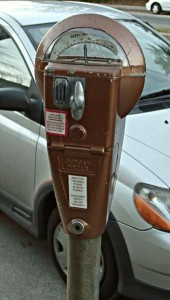
Dinosaur
Paying for parking? There’s an app for that. Or at least there should be.
Walking down a downtown sidewalk this week, I pondered a sawed-off pipe near the curb where an old-fashioned parking meter once stood. A few years ago, the City of Raleigh got rid of all the traditional coin-based parking meters and put up new electronic parking kiosks instead. Drivers simply note the painted number for their parking space and enter that into the kiosk along with their payment.
Simple, right? Instead of collecting coins from hundreds of meters, parking staff simply empty the money from kiosks, which take credit cards and paper bills in addition to coins. Drivers can also refresh their parking time from nearby kiosks, avoiding a trip back to the kiosk nearest the car.
Continue reading
Orange orbs over Cork, Ireland
Remember those mysterious floating flares I saw over Raleigh the night of Bluegrass Wide Open in September? I never did figure out what they were, nor did the city’s 911 center have any records of anyone calling about them. Yesterday, though, I came across this video someone took that shows what is purportedly fiery orange orbs descending over Cork, Ireland in December 2012.
Now, I don’t know if these are UFOs, flares, Chinese lanterns, or simply some fancy video editing. Providing there’s no photographic trickery involved, the objects are extremely bright, probably flying at a low altitude, and seem to appear out of nowhere instantly. What’s more, they look exactly like what I saw floating at a distance back on that September night.
Continue reading
We need to talk about TED | Benjamin Bratton
A critical (and much-needed) look at TED.
Instead of dumbing-down the future, we need to raise the level of general understanding to the level of complexity of the systems in which we are embedded and which are embedded in us. This is not about “personal stories of inspiration,” it’s about the difficult and uncertain work of demystification and reconceptualisation: the hard stuff that really changes how we think. More Copernicus, less Tony Robbins.
Keep calm and carry on “innovating” … is that the real message of TED? To me that’s not inspirational, it’s cynical.
via We need to talk about TED | Benjamin Bratton | Comment is free | theguardian.com.
Jacob Appelbaum explains why the NSA’s spying concerns us all
Cory at BoingBoing puts it best:
Sunday’s Snowden leaks detailing the Tailored Access Operations group — the NSA’s exploit-farming, computer-attacking “plumbers” — and the ANT’s catalog of attacks on common computer equipment and software — were accompanied by a lecture by Jacob Appelbaum at the 30th Chaos Communications Congress. I have seen Jake speak many times, but this talk is extraordinary, even by his standards, and should by watched by anyone who’s said, “Well, they’re probably not spying on me, personally;” or “What’s the big deal about spies figuring out how to attack computers used by bad guys?” or “It’s OK if spies discover back-doors and keep them secret, because no one else will ever find them.”
Also, see Der Spiegel’s sidebar feature for a look at the source documents.
Judge on NSA Case Cites 9/11 Report, But It Doesn’t Actually Support His Ruling – ProPublica
Whoopsie. Methinks His Honor didn’t want to let a little thing like basic research interrupt his holiday celebrations.
In a new decision in support of the NSA’s phone metadata surveillance program, U.S. district court Judge William Pauley cites an intelligence failure involving the agency in the lead-up to the 9/11 attacks. But the judge’s cited source, the 9/11 Commission Report, doesn’t actually include the account he gives in the ruling. What’s more, experts say the NSA could have avoided the pre-9/11 failure even without the metadata surveillance program.
via Judge on NSA Case Cites 9/11 Report, But It Doesn’t Actually Support His Ruling – ProPublica.
Canine connection
There was a quite curious phenomenon I noticed with our dog, Rocket, that took place while I was in the last days of my previous job. I could see at that point that things weren’t going to work out for me but I still continued to forge ahead and do my best. This put me under unbelievable stress, the likes I’d never felt before. The day before I lost my job I was such a nervous wreck that I could barely speak.
At this very same time, Rocket began to repeatedly smack his lips. Not just once, though, he did it all day long, something he’s never done before. I joked at the time that he must have gotten into some peanut butter or something, but in looking back I had an interesting thought.
Rocket smacks his lips when he’s feeling stressed. At the time I was feeling more stress than I ever had before. Was our dog simply reacting to the stress I was feeling? I never found any evidence he had eaten something he shouldn’t have, nor did I treat our dog any differently than usual. I can’t help but wonder if there might be something to the theory that dogs are innately attuned to moods of their masters.
A chance to blog professionally
Knowing the writing was on the wall, I decided to jump at an interesting opportunity. In September a friend contacted me out the blue, letting me know that Slate.com had an opening for a tech blogger focusing on new trends. He knew an editor at Slate and would put in a good word for me.
The job description sounded appealing:
Tech Blogger at Slate Magazine in Washington, DC
Slate is hiring a technology blogger to contribute to “Future Tense,” our blog about emerging technologies and their impact on society and public policy.
Continue reading