Google Fiber and an FCC decision could give more people cheaper access to the Internet | News Feature | Indy Week

Indyweek talked with Erica Swanson, head of Google Fiber’s Community Impact programs, about bringing broadband to all income levels.

The bad news about Google Fiber coming to seven cities in the Triangle is that the high-speed Internet service won’t be installed in your neighborhood by the next season of House of Cards.

The good news is that Google Fiber says it will seek out traditionally underserved communities—low-income, minority, non-English speaking areas, where some residents don’t have home Internet at all.

About 60 million people in the U.S. don’t have Internet at home, according to the Pew Research Center. In cities, that number is 1 in 4. For some, a computer and a connection are too expensive; others say they don’t need it—the Internet has no place in their lives.

That might change, hinging on Google’s expansion plans, along with a pending decision by the FCC, that could give more people cheaper access to the Internet.

"Affordable connectivity, that’s the piece we can address," says Erica Swanson, Google’s head of Community Impact Programs.
via Google Fiber and an FCC decision could give more people cheaper access to the Internet | News Feature | Indy Week.

R-Line envy

R-Line-BikeOnBus
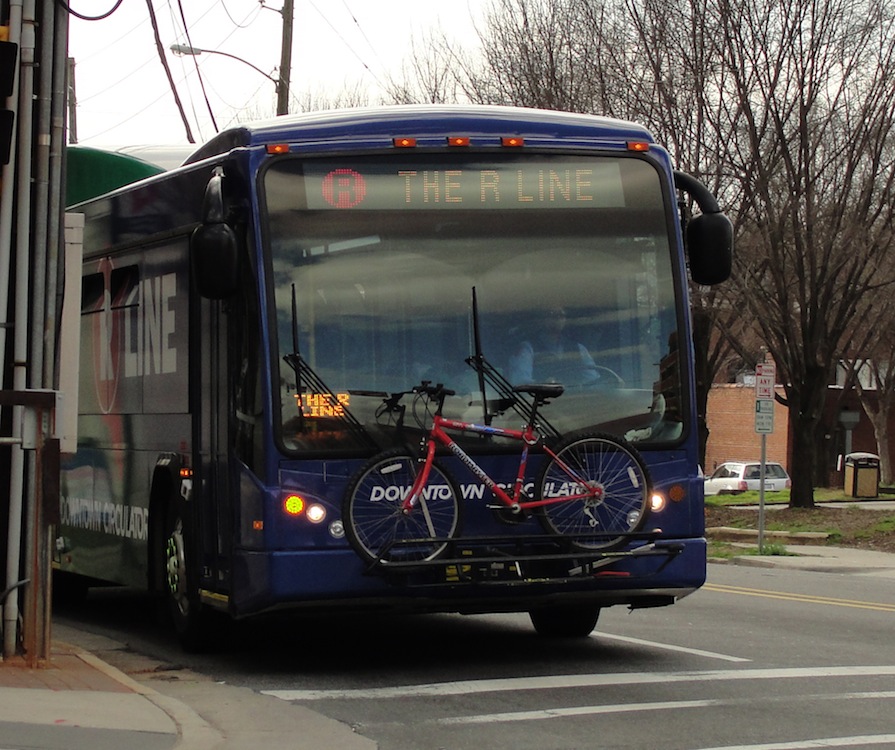
Speaking of transit, I see that the marketing director for Cameron Village is trying to drum up support for diverting the R-Line buses from the original mission of serving downtown Raleigh. I’m all for improved transportation around Cameron Village because trying to drive anywhere around there is a nightmare. That said, I’m not sure extending the R-Line is the answer.

The R-Line buses came about through a joint effort of the Raleigh Transit Authority, the Downtown Raleigh Alliance (DRA), and the Greater Raleigh Convention and Visitors Bureau (GRCVB). All three groups helped make the R-Line possible. Cameron Village is not part of DRA and I don’t see that they do much with the GRCVB. Is the shopping center proposing to help pay for this extended service the way these other groups have? If so, I haven’t heard it. It would be great to get everything for free, but someone has to pick up the tab.

Cameron Village already has city bus service (two routes, 12 and 16). It makes sense to improve this existing service and leave the R-Line to do what it’s been doing: giving visitors an easy way to get around downtown Raleigh. That’s why downtown businesses subsidize it.

N&O’s Christensen gets light rail wrong

The N&O’s Rob Christensen makes the classic light rail vs. commuter rail blunder in this week’s column. If the media can’t even properly explain the difference between light rail and commuter rail, how do we ever expect the public to understand?

When it comes to a light-rail system for Raleigh, label me a skeptic.

I am a believer in buses, and I think our bus system should be expanded and more bus shelters erected.

Before we sink huge bundles of money into a light-rail system, I think a stronger case needs to be made, given our limited resources.

He also misidentifies the real problem with our bus system, which is it’s unusable to all but those who have no other choice. I’ve written about that before.

via Christensen: Raleigh needs buses, not rail | Rob Christensen | NewsObserver.com.

Taking aim at Gage’s Google Fiber op-ed

I submitted this letter to the editor to the N&O today. I trust they’ll agree with it and run it to correct the errors in the abysmal op-ed they ran last week.

Dawson Gage’s recent opinion piece about Google Fiber was deeply flawed. No public infrastructure is being “handed over” to Google. In actuality, Google will buy or build its infrastructure like any other provider. Gage also alleges Google was “deeply involved in the illegal, secret surveillance” when in fact much evidence exists to the contrary. Furthermore, how Gage can suggest that broadband hasn’t enriched our lives is bizarre and puzzling.

I know Google Fiber’s arrival is exciting news but let’s keep our heads, please.

Mark Turner
Raleigh, NC
Founder, Bring Google Fiber to Raleigh! Facebook Group

Update 6 Feb: The N&O ran my letter today. Gave it a headline of “Google all good.” I’m not sure I’d go that far, but at least someone has now set the record straight. On the same page, though, another letter writer repeated Gage’s “public giveway” premise. Sigh.

What does it Mean to be a Gig City? Upload Speeds Powering Entrepreneurs — Next Century Cities

Remember when I pointed out the secret sauce of Google Fiber is the upload speeds? Will Aycock, operations manager of Wilson’s Greenlight community broadband system, agrees.

It’s all about the upload. If you are the owner of a small engineering business with dense blueprints to send to your European clients, or a specialized country doctor who depends on the quick transmission of x-rays, a digital film effects company, or a media artist, your ability to upload your dense information to your clients means business. For GigCity, Wilson, North Carolina, offering gigabit upload speeds to its community is real business for its future.

via What does it Mean to be a Gig City? Upload Speeds Powering Entrepreneurs — Next Century Cities.

The FCC is moving to preempt state broadband limits – The Washington Post

It looks increasingly likely that the FCC will overturn North Carolina’s anti-municipal broadband law, freeing cities like Wilson, NC to provide broadband to whomever it chooses.

Federal regulators are moving ahead with a proposal to help two cities fighting with their state governments over the ability to build public alternatives to large Internet providers.

The Federal Communications Commission this week will begin considering a draft decision to intervene against state laws in Tennessee and North Carolina that limit Internet access operated and sold by cities, according to a senior FCC official. The agency’s chairman, Tom Wheeler, could circulate the draft to his fellow commissioners as early as Monday and the decision will be voted on in the FCC’s public meeting on Feb. 26.

Chairman Wheeler just released the following statement:

FCC Chairman Tom Wheeler issued the following statement today regarding a proposed Order on community broadband that he will circulate to his fellow commissioners this week:

“Communities across the nation know that access to robust broadband is key to their economic future – and the future of their citizens. Many communities have found that existing private-sector broadband deployment or investment fails to meet their needs.

They should be able to make their own decisions about building the networks they need to thrive. After looking carefully at petitions by two community broadband providers asking the FCC to pre-empt provisions of state laws preventing expansion of their very successful networks, I recommend approval by the Commission so that these two forward-thinking cities can serve the many citizens clamoring for a better broadband future.”

I wonder if this means the FCC can also veto any spending limitations that state law has shackled municipalities with?

via The FCC is moving to preempt state broadband limits – The Washington Post.

Vets study links PB pills, genetic variations to Gulf War illness | TribLIVE

A government-issued pill intended to protect troops from nerve agents may have made some troops more vulnerable to a chronic condition marked by headaches, cognitive problems, pain and fatigue, researchers say.

People with certain genetic variations were 40 times more likely to contract Gulf War illness if they took pyridostigmine bromide, or PB, pills that the Defense Department issued to protect them from soman, a nerve agent, during the 1990-91 war, researchers concluded in a study funded by the U.S. Army Medical Research and Materiel Command and published this month in the journal Environmental Health.

via Vets study links PB pills, genetic variations to Gulf War illness | TribLIVE.

Yes, Walking Through A Doorway Really Does Make You Forget — Here’s Why – Forbes

I forgot to post this earlier.

More often than I care to admit, I’ll walk from one room to another with a clear vision in mind of whatever I need to do once I get there, but then I get there and can’t remember why I started. The only thing that happened between my first movement and my last is that I walked through a doorway. Surely that has nothing at all to do with forgetting something I knew just moments before, right?

Wrong, says new research. As it turns out, walking through a doorway exerts an imperceptible influence on memory. In fact, merely imagining walking through a doorway can zap memory.

via Yes, Walking Through A Doorway Really Does Make You Forget — Here's Why – Forbes.

Is It Time To Kill The K-Cup, Before It Kills Our Planet?

We have these coffee machines at work and they sure do produce a lot of trash for the amount of coffee they produce.

Your Keurig coffee pods have a dirty little secret. Actually, make that a big secret.

In 2013, Keurig Green Mountain produced 8.3 billion K-Cups that were brewed on millions of machines around the world — enough to circle to globe 10.5 times. Last year, production rose to nearly 9.8 billion, and most of those pods are not recyclable.

A new video made by Canadian production company Egg Studios takes a look at the environmental impact our coffee addiction has created. Titled "Kill The K-Cup," the short showcases a dystopian future where a single-use coffee pod monster destroys everything in its path.

via Is It Time To Kill The K-Cup, Before It Kills Our Planet?.

N&O runs horrible broadband op-ed

The Google Fiber op-ed that ran in today’s N&O entitled “Google Fiber deal not in best interest of NC public” is so godawful that I don’t even know where to begin. Written by Dawson Gage, who calls himself an “IT worker, freelance writer, and aspiring law student,” it is incredibly misinformed on so many levels:

I rejoiced when my family first got broadband Internet when I was about 13, but I doubt it has made any of our lives richer or more productive. The usefulness of computers, for the most part, has little enough to do with how fast they are. No one wants delivery vans and school buses that go 20,000 mph.

Is Gage actually suggesting that life isn’t richer than in the days of dialup? Before YouTube, NetFlix, Wikipedia, Facebook, and Google? Apparently, having a mind-blowing amount of the world’s information instantly available isn’t rich or more productive enough for him. I bet he’s a big fan of the abacus.
Continue reading