5 reasons why you shouldn’t work too hard

Nice look at what we Americans are losing in our insistence in becoming slaves to work.

The first time the commercial aired during the Opening Ceremonies in Sochi, the slight pause after those two questions made me hopeful. I sat up to listen closely.

Was he about to say – we should be more like that? Because Americans work among the most hours of any advanced country in the world, save South Korea and Japan, where they’ve had to invent a word for dying at your desk. Karoshi. Death from Overwork. We also work among the most extreme hours, at 50 or more per week. The Bureau of Labor Statistics reports that the average American works about one month more a year than in 1976.

Was he going to say that we Americans are caught up in what economist Juliet Schor calls a vicious cycle of “work-and-spend” – caught on a time-sucking treadmill of more spending, more stuff, more debt, stagnant wages, higher costs and more work to pay for it all?

via 5 reasons why you shouldn’t work too hard.

Everyone In The Tech And TV Industries Is Passing Around This Speech By Kevin Spacey – Business Insider

House of Cards star Kevin Spacey explains why the traditional TV model is quickly going extinct. This five minute excerpt of one of his recent speeches is well worth watching.

Everyone in the tech industry is passing around this video of Kevin Spacey talking about how Netflix and other tech companies will blow up the traditional TV industry. In an edited version of Spacey’s speech below, he touches on how Netflix, which has produced a handful of excellent original series this year, has the potential to disrupt the traditional cable and network TV model of forcing content creators to make a pilot before accepting a show.For example, Spacey says there will be 146 pilots made this year at the cost of $300-$400 million. Only 56 of those will actually be made into a series. "That makes our ‘House of Cards’ deal for two seasons really cost effective," Spacey says in the speech.

via Everyone In The Tech And TV Industries Is Passing Around This Speech By Kevin Spacey – Business Insider.

Official Blog: Exploring new cities for Google Fiber

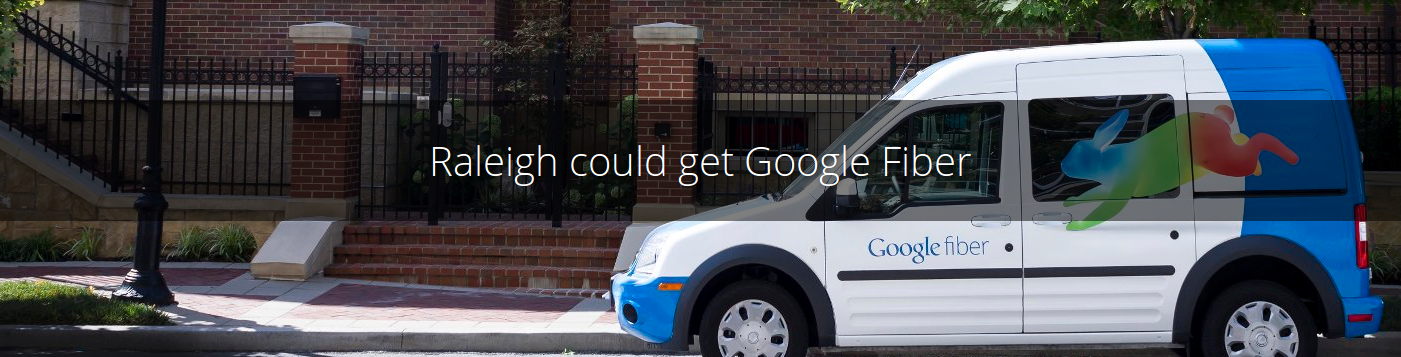
Google Fiber coming to Raleigh?

Google Fiber coming to Raleigh?


Google is considering the Triangle area for its next rollout of Google Fiber! As a veteran of the broadband fights here in North Carolina and the founder of the Bring Google Fiber to Raleigh! Facebook group, I am thrilled that we’re being considered for this.

Last week’s snowstorm provided me a perfect use case for Google Fiber. I was itching to organize a musical jam session with a few neighbors only travel conditions were too dangerous to all get together in one place. While one can do video chats with our current, abysmally-slow broadband connections, playing in time with others remotely requires highly-synchronized connections. These could be done with low-bandwidth and exorbitantly-priced ISDN circuits or on high-bandwidth, uncompressed fiber networks like Google Fiber.

I think adding Google Fiber to our area’s mix will benefit our musicians as much as our techno-geeks, pharmaceutical scientists and our other traditional area jobs.

Over the last few years, gigabit Internet has moved from idea to reality, with dozens of communities PDF working hard to build networks with speeds 100 times faster than what most of us live with today. People are hungrier than ever for faster Internet, and as a result, cities across America are making speed a priority. Hundreds of mayors from across the U.S. have stated PDF that abundant high-speed Internet access is essential for sparking innovation, driving economic growth and improving education. Portland, Nashville PDF and dozens of others have made high-speed broadband a pillar of their economic development plans. And Julian Castro, the mayor of San Antonio, declared in June that every school should have access to gigabit speeds by 2020.

We’ve long believed that the Internet’s next chapter will be built on gigabit speeds, so it’s fantastic to see this momentum. And now that we’ve learned a lot from our Google Fiber projects in Kansas City, Austin and Provo, we want to help build more ultra-fast networks. So we’ve invited cities in nine metro areas around the U.S.—34 cities altogether—to work with us to explore what it would take to bring them Google Fiber.

via Official Blog: Exploring new cities for Google Fiber.

The Open-Office Trap : The New Yorker

Interesting. I’m not a fan of open offices.

The open office was originally conceived by a team from Hamburg, Germany, in the nineteen-fifties, to facilitate communication and idea flow. But a growing body of evidence suggests that the open office undermines the very things that it was designed to achieve. In June, 1997, a large oil and gas company in western Canada asked a group of psychologists at the University of Calgary to monitor workers as they transitioned from a traditional office arrangement to an open one. The psychologists assessed the employees’ satisfaction with their surroundings, as well as their stress level, job performance, and interpersonal relationships before the transition, four weeks after the transition, and, finally, six months afterward. The employees suffered according to every measure: the new space was disruptive, stressful, and cumbersome, and, instead of feeling closer, coworkers felt distant, dissatisfied, and resentful. Productivity fell.

via The Open-Office Trap : The New Yorker.

Shiny craft in sky

At 7:27 AM Saturday, I was running late to meet my brothers and dad for breakfast downtown. As I hurriedly turned south onto Blount Street from Peace Street, I spotted a very bright object in the eastern sky, roughly above Oakwood Cemetery. It seemed to be stationary and extremely shiny. The bottom half glowed brilliant amber. It could’ve been catching the morning sun that was rising behind it.

Was it an airplane? Normally I’d say so, but in the second it took me to look back at the road and then back to the sky it seemed to vanish. It wasn’t shaped like an airplane but was more spherical, perhaps even oblong or diamond-shaped. It was so reflective to be almost mirror-like. There were no visible navigation lights, either, nor was this airplane on any flight path to or from RDU airport.

There are general aviation planes which are silver but these are rare in my experience. Most small planes are painted. Helicopters are normally painted as well. I don’t ever recall seeing one so reflective – certainly none of the usual TV news helicopters common around here.

Am I a little spooked by the other weird lights I’ve seen recently over Raleigh? You bet. That doesn’t mean what I saw yesterday is anything but some shiny, everyday aircraft. Even so, I sure wish I would’ve had some extra time to investigate it.

Flu shot effectiveness below 50 percent

My friends are making noise about getting a flu vaccine. I am not anti-vaccine at all, but not all vaccines are the same. And not all flu vaccines are the same, either. Each season’s flu vaccine is a coin toss whether it will actually work. According to CDC statistics, patients 65 or older who got a flu shot during the 2012-2013 season were only protected from flu an abysmally-low 9% of the time.

There is also evidence from the CDC that repeatedly getting flu shots makes you more susceptible to getting the flu.

There are a lot of claims being made about the flu vaccine, including a lot of hype. I think it’s important to pay attention to what the science tells you.

The flu vaccine was 47% effective against medically attended flu for all influenza strains in the 2011-12 season, and being vaccinated the year before lowered effectiveness, according to a study yesterday in Clinical Infectious Diseases.

US researchers from the Centers for Disease Control and Prevention and elsewhere looked at complete data for the season, which was relatively mild and peaked late. They found an overall vaccine effectiveness VE of 47% for preventing medically attended flu.

VE against 2009 H1N1 was 65%, but against H3N2, which was the predominant strain during the 2011-12 season. VE was only 39%. Its effectiveness against type B strains was 58% but was actually lower against the Victoria strain included in the vaccine 52% compared with the Yamagata strain not included in the vaccine 66%.

The investigators also noted a statistically significant difference between VE for those who received a flu vaccine the year before 33% and those who did not 56%.

via Flu Scan for Nov 14, 2013 | CIDRAP.

On the Matter of Why Bitcoin Matters — The Magazine on Medium

Glenn Fleishman, frequent contributor to The Economist, takes a closer look at Marc Andreessen’s recent NY Times opinion piece about Bitcoin.

Marc Andreessen wrote an essay for the New York Times about Bitcoin, “Why Bitcoin Matters,” in which he attempts to explain the relevancy of the digital currency for the future of commercial transactions. He uses analogies, allegories, history, and ostensible facts to build his case.

However, I believe he fundamentally misrepresents or misunderstands key aspects of the technology, ecosystem, and impact, despite Andreessen Horowitz, of which he is a founding partner, having just under $50m in investment fully disclosed in “Bitcoin-related startups.” I own no Bitcoins; Marc has a “de minimis” amount. I will note that someone owning Bitcoin investments and not Bitcoins is the same as owning gold-mine investments and no gold.

via On the Matter of Why Bitcoin Matters — The Magazine on Medium — Medium.

Why Bitcoin Matters – NYTimes.com

Internet pioneer Marc Andreessen explains the promise of Bitcoin. I thought I understood these concepts well enough but this showed me new possibilities.

That last part is enormously important. Bitcoin is the first Internetwide payment system where transactions either happen with no fees or very low fees (down to fractions of pennies). Existing payment systems charge fees of about 2 to 3 percent – and that’s in the developed world. In lots of other places, there either are no modern payment systems or the rates are significantly higher. We’ll come back to that.

Bitcoin is a digital bearer instrument. It is a way to exchange money or assets between parties with no pre-existing trust: A string of numbers is sent over email or text message in the simplest case. The sender doesn’t need to know or trust the receiver or vice versa. Related, there are no chargebacks – this is the part that is literally like cash – if you have the money or the asset, you can pay with it; if you don’t, you can’t. This is brand new. This has never existed in digital form before.

via Why Bitcoin Matters – NYTimes.com.

Nasa says Mars mystery rock that ‘appeared’ from nowhere is ‘like nothing we’ve seen before’ – Science – News – The Independent

This is bizarre.

A mysterious rock which appeared in front of the Opportunity rover is “like nothing we’ve ever seen before”, according to Mars exploration scientists at Nasa.

Experts said they were “completely confused” by both the origins and makeup of the object, which is currently being investigated by Opportunity’s various measuring instruments.

via Nasa says Mars mystery rock that ‘appeared’ from nowhere is ‘like nothing we’ve seen before’ – Science – News – The Independent.

Here’s the referenced Mars status report from NASA.