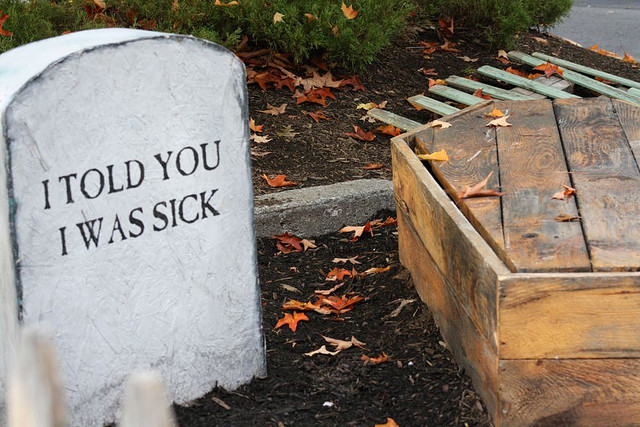
Death dream

i-told-you-i-was-sick

I don’t normally post about my dreams but this one has been on my mind. An entry from my dream journal, dated 16 July 2013:

I dreamt that I had 1,346 more days to live. I would die of an expensive disease like cancer, one that would stretch the limits of my health insurance. It was all matter-of-fact. According to the calculator on timeanddate.com, 1,346 days from now is Thursday, 23 March 2017. Of course, I am not ready to die and almost certainly won’t be ready on 23 March 2017. Even so, it makes me consider how I might choose to spend these days if I know I only have x number left.

To add some detail, I was told in my dream by someone in authority that this was how many days I had left to live. It was simply explained to me that this was how it was going to be. This was my fate. And it did seem matter-of-fact, as if this was the plan I had agreed to all along. I recall not being particularly excited or concerned about the news.

And the way the data was presented in days rather than a date really stuck with me. It is a very unusual way of conveying that information, perhaps so that I would better remember it.

Dreams don’t always come true. I know this. This dream had a very sober reality that I can’t ignore, though. It is an important message to me.

So if it’s wrong, we will all have a good laugh. I will go ahead and pen a future blog entry, scheduled to post on 24 March 2017. With good fortune perhaps I will mock it along with everyone else. In the meantime, though, I am going to take in as much as I can in the 696 days I might have left.

Because you never knows when you might die. Or do you?

Google View

Sitting in the dentist’s chair, enduring the agony of another teeth cleaning yesterday, I thought of the perfect use for the Google Fiber system coming to Raleigh.

I was being forced to watch Time Warner Cable’s News14 channel in front of me and thinking about how TWC’s local news model works. It didn’t take many minutes of watching the video (thankfully without audio, as the suction hose was often going) to realize how boilerplate it is. The TWC guys have an establishing shot, then zoom in on something dumb like police lights reflecting off the stolen car, then move on to another thing. It was obvious that the video doesn’t really tell the story – in fact, it is repetitive and dull. I could choose not to look up between rinses and feel like I didn’t really miss anything.
Continue reading

Google Fiber: Kansas City offers Charlotte ‘Digital Divide’ lessons | The Charlotte Observer The Charlotte Observer

CharO talks about Google Fiber and the Digital Divide

In a past job in Kansas City, Julie Porter was part of an intense, door-to-door campaign to get residents in economically challenged, mostly minority neighborhoods to sign up for Google’s high-speed Internet service.

Community organizers didn’t want residents in these areas to face an even wider Digital Divide.

Now the head of a Charlotte housing agency, Porter has urged local leaders here to get an early start encouraging residents to embrace broadband service, long before Google Fiber makes its planned Charlotte debut.

“It was just very, very challenging,” said Porter, president of the Charlotte-Mecklenburg Housing Partnership, of the Kansas City situation. “I wanted to make sure that Charlotte didn’t have the same experience.”

via Google Fiber: Kansas City offers Charlotte ‘Digital Divide’ lessons | The Charlotte Observer The Charlotte Observer.

Historic moment: Saudi Arabia sees End of Oil Age coming and opens valves on the carbon bubble – EnergyPost.eu

This is a fascinating read about the oil market that took me a while to really get, but it finally makes sense.

Tl;dr The Saudis are selling all the oil they can now because they’re worried that oil is quickly becoming obsolete. They’d rather sell at a drastic discount than be left with oceans of oil but no buyers.

Most analysts believe Saudi Arabia refuses to cut production because it wants to shake out its higher-cost competitors or because it wants to punish Iran and Russia. There may be some truth in those theories, writes Elias Hinckley, strategic advisor and head of the energy practice with international law firm Sullivan and Worcester, but they miss the deeper motivation of the Saudis. Saudi Arabia, he says, sees the end of the Oil Age on the horizon and understands that a great deal of global fossil fuel reserves will have to stay underground to avoid catastrophic global warming. “That’s why it has opened the valves on the carbon asset bubble.”

via Historic moment: Saudi Arabia sees End of Oil Age coming and opens valves on the carbon bubble – EnergyPost.eu.

Wilson’s official statement on today’s FCC ruling

Here is Wilson’s official statement on today’s FCC ruling.

CITY OF WILSON APPLAUDS FCC CHAIRMAN WHEELER AND THE COMMISSION FOR ITS LEADERSHIP IN DECIDING IN FAVOR OF LOCAL BROADBAND CHOICE

Wilson, N.C. — The City of Wilson applauds FCC Chairman Wheeler and the Commission for their leadership today in approving the City’s petition to preempt a North Carolina state law that restricts municipal Gigabit broadband deployment. Today’s historic decision now enables Wilson and other North Carolina municipalities to provide the Gigabit broadband infrastructure and services that North Carolina and America need in order to remain competitive in our emerging knowledge-based global economy.
Continue reading

The FCC rules against state limits on city-run Internet – The Washington Post

Wilson’s petition to the FCC was just granted and I couldn’t be happier. North Carolina’s “Level Playing Field” law, written by Time Warner Cable, is now null and void. Now communities across the state can build themselves their own digital future with a community broadband service.

I would be dancing in the street if the street wasn’t a slushy mess right now!

For years, cities around the country have been trying to build their own, local competitors to Verizon, Charter and other major Internet providers. Such government-run Internet service would be faster and cheaper than private alternatives, they argued. But in roughly 20 states, those efforts have been stymied by state laws.

Now, the nation’s top telecom regulators want to change that. On Thursday, the Federal Communications Commissions voted 3-2 to override laws preventing Chattanooga, Tenn., and Wilson, N.C. from expanding the high-speed Internet service the cities already offer to some residents.

via The FCC rules against state limits on city-run Internet – The Washington Post.

Why Tesla’s battery for your home should terrify utilities | The Verge

Telsa and SolarCity are working on a residential battery that might let people drop off the electric grid completely. The utilities are sweating.

Earlier this week, during a disappointing Tesla earnings call, Elon Musk mentioned in passing that he’d be producing a stationary battery for powering the home in the next few months. It sounded like a throwaway side project from someone who’s never seen a side project he doesn’t like. But it’s a very smart move, and one that’s more central to Musk’s ambitions than it might seem.

via Why Tesla's battery for your home should terrify utilities | The Verge.

Google Fiber and an FCC decision could give more people cheaper access to the Internet | News Feature | Indy Week

Indyweek talked with Erica Swanson, head of Google Fiber’s Community Impact programs, about bringing broadband to all income levels.

The bad news about Google Fiber coming to seven cities in the Triangle is that the high-speed Internet service won’t be installed in your neighborhood by the next season of House of Cards.

The good news is that Google Fiber says it will seek out traditionally underserved communities—low-income, minority, non-English speaking areas, where some residents don’t have home Internet at all.

About 60 million people in the U.S. don’t have Internet at home, according to the Pew Research Center. In cities, that number is 1 in 4. For some, a computer and a connection are too expensive; others say they don’t need it—the Internet has no place in their lives.

That might change, hinging on Google’s expansion plans, along with a pending decision by the FCC, that could give more people cheaper access to the Internet.

"Affordable connectivity, that’s the piece we can address," says Erica Swanson, Google’s head of Community Impact Programs.

via Google Fiber and an FCC decision could give more people cheaper access to the Internet | News Feature | Indy Week.

N&O’s Christensen gets light rail wrong

The N&O’s Rob Christensen makes the classic light rail vs. commuter rail blunder in this week’s column. If the media can’t even properly explain the difference between light rail and commuter rail, how do we ever expect the public to understand?

When it comes to a light-rail system for Raleigh, label me a skeptic.

I am a believer in buses, and I think our bus system should be expanded and more bus shelters erected.

Before we sink huge bundles of money into a light-rail system, I think a stronger case needs to be made, given our limited resources.

He also misidentifies the real problem with our bus system, which is it’s unusable to all but those who have no other choice. I’ve written about that before.

via Christensen: Raleigh needs buses, not rail | Rob Christensen | NewsObserver.com.

Taking aim at Gage’s Google Fiber op-ed

I submitted this letter to the editor to the N&O today. I trust they’ll agree with it and run it to correct the errors in the abysmal op-ed they ran last week.

Dawson Gage’s recent opinion piece about Google Fiber was deeply flawed. No public infrastructure is being “handed over” to Google. In actuality, Google will buy or build its infrastructure like any other provider. Gage also alleges Google was “deeply involved in the illegal, secret surveillance” when in fact much evidence exists to the contrary. Furthermore, how Gage can suggest that broadband hasn’t enriched our lives is bizarre and puzzling.

I know Google Fiber’s arrival is exciting news but let’s keep our heads, please.

Mark Turner
Raleigh, NC
Founder, Bring Google Fiber to Raleigh! Facebook Group

Update 6 Feb: The N&O ran my letter today. Gave it a headline of “Google all good.” I’m not sure I’d go that far, but at least someone has now set the record straight. On the same page, though, another letter writer repeated Gage’s “public giveway” premise. Sigh.