Combat veterans shoot down NRA ‘fantasy world’ of ‘good guys with guns’

The NRA loves to parrot the thinking that it takes a good guy with a gun to stop a bad guy with a gun. They say this because they want to encourage gun ownership and, sadly, many conservatives think that they can be the savior in the case of a mass shooting.

A journalist asked combat veterans how this would work out and predictably they were not impressed (see story below).

It reminded me of something that was emphasized time and again in my CERT training:

In a crisis, you will always fall back to your training.

Continue reading

The King of Beers Wants to Push Craft Brews out of Your Supermarket | Mother Jones

What’s a brewer to do? How about brewing something its customers actually want to drink?

Pity Anheuser-Busch InBev, the Belgian-owned behemoth responsible for such beloved US beers as Budweiser, Bud Light, and Michelob Ultra. When InBev bought US beer giant Anheuser-Busch back in 2008, the company accounted for 49 percent of the US beer market, the Wall Street Journal reported. Since then, its US market share has dipped to 45 percent. Since 2005, sales of its big domestic brands like Bud have dropped 5.7 percent, even as craft-beer sales have rocketed up 173.6 percent. What’s a transnational, industrial-scale maker of flavor-light, marketing-heavy brews to do?

Source: The King of Beers Wants to Push Craft Brews out of Your Supermarket | Mother Jones

Gag Order Gone, Secrets of a National Security Letter are Revealed | FRONTLINE

An interview with Nicholas Merrill who, after 11 years of court battles, can now discuss the National Security Letter that the FBI gagged him with.

There are ways to legally compel information, they’re called warrants. Instead we have a security state that’s run amok. Funny how we don’t have much safety to show for the trillions of dollars we taxpayers have poured into the national security apparatus.

For the first time in 11 years, Nicholas Merrill is allowed to fully reveal the contents of a letter that came hand-delivered to him from the FBI.

In 2004, Merrill, then the CEO of a New York-based web-hosting firm called Calyx, received a so-called national security letter. The letter asked for what Merrill described as a significant array of information from the company, but because of a gag order, he was legally barred from even speaking about it.

“It was not a warrant. It was not stamped or signed by a court or a judge,” Merrill told FRONTLINE in the 2014 film United States of Secrets. “It was this letter demanding this information from me. And it also told me that I could never tell anyone that I had gotten the letter. It said that I could tell ‘no person.’”

Source: Gag Order Gone, Secrets of a National Security Letter are Revealed | FRONTLINE

Reagan and Gorbachev Agreed to Pause the Cold War in Case of an Alien Invasion | Smart News | Smithsonian

Interesting. Did Reagan know something about aliens?

At one point during the 1985 Geneva Summit, President Ronald Reagan and Soviet Premier Mikhail Gorbachev took a break from negotiations to take a walk. Only their private interpreters were present and for years, the details of what they talked about were kept secret from both the Russian and American public. But during a 2009 interview with Charlie Rose and Reagan’s Secretary of State George Shultz, Gorbachev revealed that Reagan asked him point-blank if they could set aside their differences in case the world was invaded by aliens.

Source: Reagan and Gorbachev Agreed to Pause the Cold War in Case of an Alien Invasion | Smart News | Smithsonian

Update: You can watch Gorbachev’s comment here, beginning at the 2:53 mark.

No Damned Computer is Going to Tell Me What to Do – The Story of the Naval Tactical Data System, NTDS

This is an excellent (and extensive) history of the Navy’s Naval Tactical Data System (NTDS), the computerized mapping of threats. I worked with NTDS in the Navy but never knew how its development not only revolutionized naval warfare but also spurred the development of modern digital computers.

It was 1962. Some of the prospective commanding officers of the new guided missile frigates, now on the building ways, had found out that the Naval Tactical Data System (NTDS) was going to be built into their new ship, and it did not set well with them. Some of them came in to our project office to let us know first hand that no damned computer was going to tell them what to do. For sure, no damned computer was going to fire their nuclear tipped guided missiles. They would take their new ship to sea, but they would not turn on our damned system with its new fangled electronic brain.

We would try to explain to them that the new digital system, the first digitized weapon system in the US Navy, was designed to be an aid to their judgment in task force anti-air battle management, and would never, on its own, fire their weapons. We didn’t mention to them that if they refused to use the system, they would probably be instantly removed from their commands and maybe court martialed because the highest levels of Navy management wanted the new digital computer-driven system in the fleet as soon as possible, and for good reason.

Secretary of the Navy John B. Connally, a former World War II task force fighter director officer, and Chief of Naval Operations Admiral Arleigh A. Burke were solidly behind the new system, and were pushing the small NTDS project office in the Bureau of Ships to accomplish in five years what would normally take thirteen years. The reason behind their push was Top Secret, and thus not known even by many naval officers and senior civil servants in the top hierarchy of the navy. Senior navy management did not want the Soviet Union to know that task force air defense exercises of the early 1950s had revealed that the US surface fleet could not cope with expected Soviet style massed air attacks using new high speed jet airplanes and high speed standoff missiles.

Source: First-Hand:No Damned Computer is Going to Tell Me What to DO – The Story of the Naval Tactical Data System, NTDS – Engineering and Technology History Wiki

Scientists have figured out how to shock the salt out of seawater – ScienceAlert

Cool!

Researchers have developed a system that uses an electric shockwave to extract salt and other impurities out of salty or contaminated water, and say it could be scaled up for use in desalination or water purification plants, or be used to clean the vast amounts of dirty water produced by fracking.

Known as ‘shock electrodialysis’, the technique applies an electrically driven shockwave to a constant stream of flowing water. The current interacts with the charged salt particles, causing a stream of salty water to be pushed aside and separated from a stream of fresh water, and these are then funnelled into separate pipes.

Source: Scientists have figured out how to shock the salt out of seawater – ScienceAlert

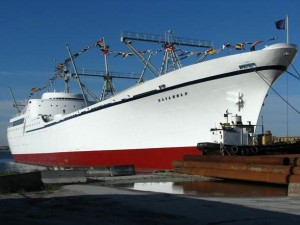
A Bold Future that Wasn’t: the NS Savannah

NS Savannah

NS Savannah (Photo by Maritime Park Association)


Behold the future.

The NS Savannah was the world’s first nuclear-powered merchant ship. She steamed for over 400,000 miles from 1962 to 1970 as the flagship of President Eisenhower’s “Atoms for Peace” initiative, but her operational costs, meager cargo capacity, and the extensive training required of the crews doomed her. She now resides at Pier 13 in Baltimore awaiting the removal of her reactor and can be toured upon request.

This site gives you a virtual-reality look at this forgotten engineering and design masterpiece. It’s a walk back in time to the more hopeful, futuristic outlook of the late 1950s. I’d love to see it in person (and it can be done by following the instructions in this FAQ list).

Welcome to the Nuclear Ship Savannah, the world’s first nuclear-powered merchant ship.

Savannah was a signature element of President Eisenhower’s Atoms for Peace program. She was constructed as a joint project of the former Atomic Energy Commission (AEC) and the Maritime Administration. She operated from 1962 to 1965 in experimental service, at which time the AEC issued her commercial operating license number NS-1. Savannah continued in demonstration service as a cargo ship until 1970 when she ended her active career. She was defueled in 1971 and her reactor made permanently inoperable in 1975-76. About 95% of the power plant is intact and remains onboard ship. Savannah is still licensed by the Nuclear Regulatory Commission (NRC is the successor to the AEC), and will remain so until nuclear decommissioning.

Source: NS Savannah – Virtual Tour

One big reason REI can decide to skip Black Friday – The Washington Post

Am I the only one sad that a retailer chooses NOT to make it’s employees work over Thanksgiving is newsworthy? Is this how far we’ve fallen? Does America really worship the almighty dollar this zealously?

Outdoor retailer REI made an announcement Monday that may have sounded like sacrilege to retail industry veterans. It will be closed this year on Black Friday, shutting its doors on retail’s holiest of days and paying its employees for a day off. Some hailed it as an unprecedented move, especially at a time when many other retailers have turned even Thanksgiving itself into a day of holiday shopping.

Source: One big reason REI can decide to skip Black Friday – The Washington Post

Little kids in Japan are independent – Business Insider

There are no helicopter parents in Japan.

It’s a common sight on Japanese mass transit: children troop through train cars, singly or in small groups, looking for seats.

They wear knee socks, polished patent leather shoes, and plaid jumpers, with wide-brimmed hats fastened under the chin and train passes pinned to their backpacks. The kids are as young as six or seven, on their way to and from school, and there is nary a guardian in sight.

Source: Little kids in Japan are independent – Business Insider

NC budget is a fiscally responsible Goldilocks document | News & Observer

N&O contributor J. Peder Zane sometimes gets it right (see Confederate monument) but the rest of the time he lives in a libertarian paradise that, frankly, doesn’t exist.

Read how he pooh poohs the Renewable Energy Investment Tax Credit, calling its repeal a “free market prod.” Well, it’s news to me that Duke Energy’s state-chartered monopoly on electricity is a “free market.” I was never the best student but I do seem to recall learning in school how a monopoly is pretty much the opposite of a free market.

I can’t wait to get this electricity free market that Zane promises. I’m sure that killing off competition is the best way to get it, right J. Peder?

Allowing the renewable energy investment tax credit to expire may be the best thing to happen to the green sector. Replacing the crutch of state support with the free market’s prod is our best hope of developing cheap, efficient renewables. It also addresses the fact that these well-intentioned subsidies have become a form of crony capitalism, sopped up by big corporations.

Source: NC budget is a fiscally responsible Goldilocks document | News & Observer