Drescher: How a blogger helped us tell a story

I got an unexpected shout-out from N&O executive editor John Drescher today about my work with the East CAC, quoted by Fiona Morgan in her New America report. We had actually all gotten together back in October after Fiona’s report was released.

I had no idea I would be the subject of Drescher’s column today, but I appreciate the shout-out. I hope other groups will be inspired to spread the word through technology!

The question to Mayor Charles Meeker came from a woman who lives in East Raleigh’s Lockwood neighborhood with her husband and two young children.

She wanted to know about the future of Powell Elementary, the school closest to her home.

Meeker harshly criticized the majority of the Wake school board. He said they were outsiders who didn’t share our values and were trying to isolate the affluent from others in separate schools.

Meeker’s comments last summer, which prompted weeks of community debate, were reported on the front page of The News & Observer. But they likely would not have received news coverage if it had not been for Mark Turner, president of the East Citizens Advisory Council, one of 18 such groups across Raleigh.

Turner, a tech professional and blogger, uses streaming video to broadcast his meetings online, where they are archived for anyone to see, including reporters.

Turner’s efforts show how citizens can help inform a community. His story was told by Fiona Morgan in a report on the availability of information in the Triangle.

via Drescher: How a blogger helped us tell a story – Drescher – NewsObserver.com.
ISS fades over Raleigh

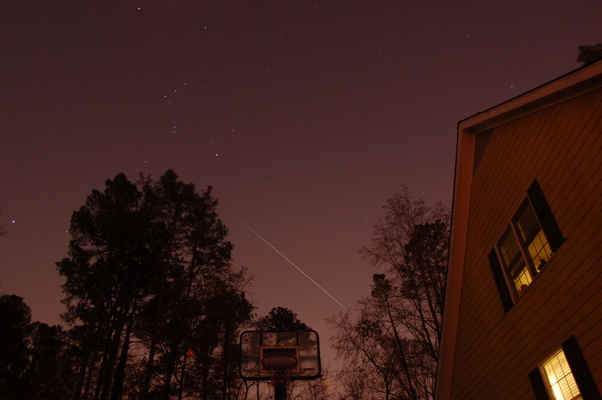
ISS fades over Raleigh

I took this photo tonight of the International Space Station as it flew over Raleigh shortly after sunset. As the space station headed northeast it passed into Earth’s shadow, making it grow noticeably darker until it was almost completely invisible. It was pretty amazing to watch it fade out as it passed halfway through the sky.

The next, potentially spectacular pass is Sunday around 6:40 PM. Right now the weather forecast calls for partly-cloudy skies but we may get lucky with another good view.

Using DSLRs for video

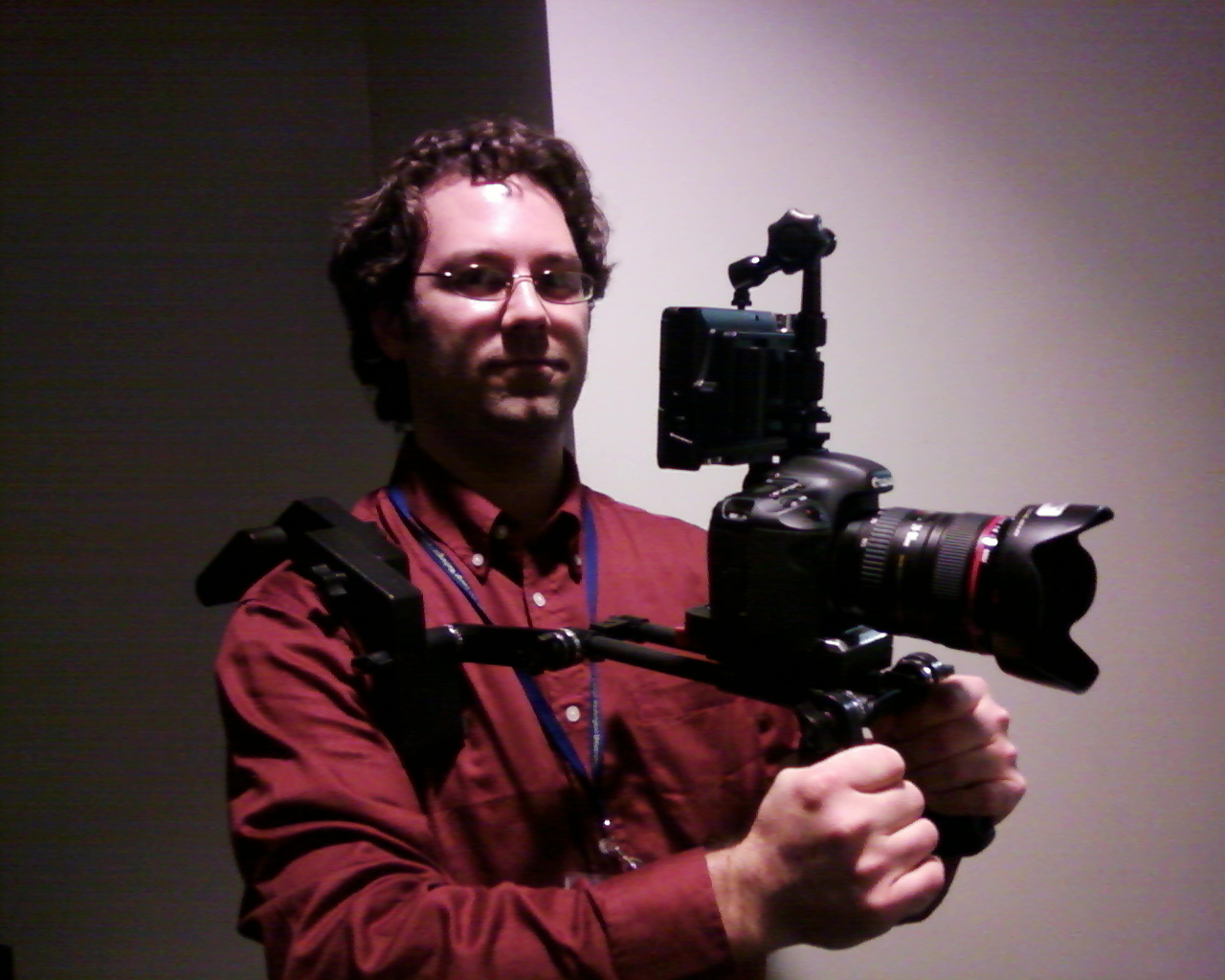
Canon consultant Patrick Reese demonstrates shooting video with a Canon EOS 7D

I went to a conference last weekend that was being video recorded. Instead of the typical DV cameras I’ve come to expect, though, the videographers were moving around the room with DSLRs. Curious that they were doing this with what I thought were still cameras, I went up to ask about their equipment.

It turns out the higher-end DSLRs (also known as HDSLRs) from Canon and Nikon are now being widely used to shoot high-quality HD video, often to the chagrin of more traditional HD camera manufacturers. A DSLR’s relatively small size and its ability to make use of exceptionally high-quality lenses makes it ideal for shooting HD.
Continue reading

Witnesses, survivor gather to remember B-52 crash

I’m reading a book about the Cold War right now and found it interesting that this reunion took place yesterday. The book, At the Abyss, An Insider’s History of the Cold War by Thomas C. Reed, discusses this Goldsboro B-52 incident and other events.

Pikeville, N.C. — Eyewitnesses, firefighters and a survivor of a 1961 crash in Wayne County involving a plane equipped with nuclear weapons gathered Tuesday to remember the day."No one knew what was happening outside," said Adam Mattocks, who was among the Air Force crew members in the B-52 plane. At the time, the plane was carrying two nuclear weapons, each one containing more than 200 times the power of the bombs that fell on Hiroshima and Nagasaki.Military officials have since said the weapons came close to detonating during the crash.

via Witnesses, survivor gather to remember B-52 crash :: WRAL.com.

Free Pool of IPv4 Address Space Depleted

The Internet’s growth reached a major milestone today when its original IP address space, IPv4, assigned the last of its free addresses. That means the Internet’s growth will now depend on the new IP addresses, IPv6.

IPv4 provided for a mere 4 billion (or 4,000,000,000) addresses. The new IPv6 provides for 340 undecillion (or 3,400,000,000,000,000,000,000,000,000,000,000,000,000) addresses. Hopefully that will last us for a while!

The Number Resource Organization NRO announced today that the free pool of available IPv4 addresses is now fully depleted. On Monday, January 31, the Internet Assigned Numbers Authority IANA allocated two blocks of IPv4 address space to APNIC, the Regional Internet Registry RIR for the Asia Pacific region, which triggered a global policy to allocate the remaining IANA pool equally between the five RIRs. Today IANA allocated those blocks. This means that there are no longer any IPv4 addresses available for allocation from the IANA to the five RIRs.

via Free Pool of IPv4 Address Space Depleted | The Number Resource Organization.

Statistician finds big flaw in scratch-off lottery tickets

Wired has a fascinating story of a statistician who found a fatal flaw in some scratch-off lottery tickets, allowing him to pick winning tickets 90% of the time.

As he points out, the games offer only the illusion of chance.

Srivastava realized that the same logic could be applied to the lottery. The apparent randomness of the scratch ticket was just a facade, a mathematical lie. And this meant that the lottery system might actually be solvable, just like those mining samples. “At the time, I had no intention of cracking the tickets,” he says. He was just curious about the algorithm that produced the numbers. Walking back from the gas station with the chips and coffee he’d bought with his winnings, he turned the problem over in his mind. By the time he reached the office, he was confident that he knew how the software might work, how it could precisely control the number of winners while still appearing random. “It wasn’t that hard,” Srivastava says. “I do the same kind of math all day long.”

That afternoon, he went back to work. The thrill of winning had worn off; he forgot about his lunchtime adventure. But then, as he walked by the gas station later that evening, something strange happened. “I swear I’m not the kind of guy who hears voices,” Srivastava says. “But that night, as I passed the station, I heard a little voice coming from the back of my head. I’ll never forget what it said: ‘If you do it that way, if you use that algorithm, there will be a flaw. The game will be flawed. You will be able to crack the ticket. You will be able to plunder the lottery.’”

via Cracking the Scratch Lottery Code | Wired Magazine.

Could the Internet be shut down in US?

Wally Bowen of the Mountain Area Internet Network ponders whether the U.S. could be cut off from the Internet the way Egypt was.

After seeing what some anti-spam servers can do, I can say wholeheartedly that it can.

On National Public Radio last Saturday, host Scott Simon opined that a “central shutdown” of the Internet as occurred in Egypt was “unthinkable if not impossible” in the United States given the “thousands of Internet routes and providers” here.

Simon noted that Egypt’s four primary Internet service providers could be shut down “with just a few phone calls.” But the U.S. has only four companies — Comcast, Time-Warner, AT&T and Verizon — controlling most of our broadband access. More than 90 percent of U.S. broadband users have only one or two providers, a cable or telephone company, to choose from.

via Could the Internet be shut down in US? | citizen-times.com | Asheville Citizen-Times.

Facebook now offers secure connections


Facebook’s porous security model is one reason why I never “link” my Facebook account to other websites.

Facebook finally provided a way to keep any random jerk in the café from hijacking your account. But you have to go out of your way to enable this protection, and you might have to wait. Still: Jump on this.

Facebook has at long last offered an option to use the encrypted HTTPS protocol, a feature it will begin rolling out today but won’t finish for a “few weeks.” You should check now if it’s available, and sign up as soon as it is enabled for your account. The performance overhead is minor—zippy Gmail, for example, uses HTTPS for everything—and it’s an important step to keep your Facebook account safe from being hijacked on an open or poorly secured wireless network.

via The Facebook Setting You Should Change as Quickly as Possible.