Streaming live video from the 3DR Solo

I have had a 3DR Solo drone since last summer and have been looking for interesting ways to expand its capabilities. One thing that I thought should be possible is to stream live video from the drone while it’s in flight. The Solo controller has an HDMI port to push video to a monitor but I wanted to see if I could get to the video stream directly, through software. I’m proud to say that I figured out how to do it.

First you need a separate computer, preferably a laptop or something portable. The computer will need to connect to the WiFi network that the Solo controller creates. Once you’ve got your computer joined, make sure it’s connected by pinging the controller (IP address 10.1.1.1).

Next, create an SDP file on your laptop as discussed on the 3DR Solo wiki.

c=IN IP4 10.1.1.1
m=video 5600 RTP/AVP 96
a=rtpmap:96 H264/90000
t=0 0

… save this as sololink.sdp.

The controller will only stream video if it’s got a TCP connection from the host requesting a stream. In a terminal window, connect to the controller as follows:

telnet 10.1.1.1 5502

or

nc 10.1.1.1 5502

Now the controller should be able to stream video using a tool such as VLC or ffmpeg. For VLC, open the osololink.sdp file you created above. You should see the drone video appear on your laptop. VLC is nice for checking the video but I haven’t worked out how to send it to YouTube yet. I believe it does not properly handle the RTMP media format that YouTube needs, though I’m not sure of this.
Continue reading

Internet everywhere

Two recent events converged in my mind. Yesterday, I attended Google’s grand opening of its Fiber Space in Raleigh, where gigabit Internet connections are the norm. And on Saturday afternoon, I was in Garner’s Southeast Regional Library to pick up Hallie and observed that all but two of the library’s Internet terminals were occupied. It made me sad that in the years since I watched a mom and her son turned away from the library when no computers were available that a shortage of Internet access is still seems to be a problem.

I hope the big-gun Internet providers like Google Fiber, AT&T, and the rest continue working to provide Internet access to the people who need it most.

Google Fiber debuts in Raleigh, opens home on Glenwood South | News & Observer

Here’s the full N&O article about the Google Fiber Space grand opening.

RALEIGH – After months of building hype for its services, Google Fiber is offering high-speed internet to its first Raleigh customers and opening a retail office in the city.The tech giant is now offering its fiber services to homes in the area around North Hills known as Midtown, mostly along Six Forks Road and the Beltline. In doing so it provides those residents a high-speed alternative to AT&T, which already offers the same speeds for the same price in Raleigh.

As part of the rollout, Google Fiber is opening its regional office in the former 518 West restaurant space at the corner of Jones Street and Glenwood Avenue in downtown Raleigh.

“This will be a place where people can come experience the future of the internet,” said Erik Garr, Google Fiber’s regional manger in the Southeastern United States.

Source: Google Fiber debuts in Raleigh, opens home on Glenwood South | News & Observer

Google Fiber Space Grand Opening

I attended the grand opening of Raleigh’s Google Fiber Space today on my lunch break. It was a good chance to check things out for myself and to say hi to some of the Googlers (and other techies) I know.

While I was there, N&O photojournalist Travis Long interviewed me about what Google Fiber means. I didn’t go there expecting to be interviewed but I always enjoy talking about the wonders of broadband.

How Sony, Microsoft, and Other Gadget Makers Violate Federal Warranty Law | Motherboard

There are big “no trespassing” signs affixed to most of our electronics.

If you own a gaming console, laptop, or computer, it’s likely you’ve seen one of these warnings in the form of a sticker placed over a screw or a seam: “Warranty void if removed.

”In addition, big manufacturers such as Sony, Microsoft, and Apple explicitly note or imply in their official agreements that their year-long manufacturer warranties—which entitle you to a replacement or repair if your device is defective—are void if consumers attempt to repair their gadgets or take them to a third party repair professional.

What almost no one knows is that these stickers and clauses are illegal under a federal law passed in 1975 called the Magnuson-Moss Warranty Act.

Source: How Sony, Microsoft, and Other Gadget Makers Violate Federal Warranty Law | Motherboard

NASA Team Claims ‘Impossible’ Space Engine Works—Get the Facts

A paper describing NASA’s spooky new EMDrive microwave propulsion engine has survived peer review. Scientists are still scratching their heads over how this seemingly impossible engine appears to work. Cool!

After years of speculation, a maverick research team at NASA’s Johnson Space Center has reached a milestone that many experts thought was impossible. This week, the team formally published their experimental evidence for an electromagnetic propulsion system that could power a spacecraft through the void—without using any kind of propellant.

According to the team, the electromagnetic drive, or EmDrive, converts electricity into thrust simply by bouncing around microwaves in a closed cavity. In theory, such a lightweight engine could one day send a spacecraft to Mars in just 70 days.

Source: NASA Team Claims ‘Impossible’ Space Engine Works—Get the Facts

T-Mobile trips Google’s security measures

This afternoon Kelly forwarded me an alarming-looking email purportedly from Google and asked me to see if it was a phishing attempt. “Someone has your password,” warned the emails. Kelly is rightfully suspicious of any unexpected email claiming that one’s account is locked or compromised so I thought this was just another phishing attempt.

Fraud or not? Always be on guard!

Fraud or not? Always be on guard!

But then I looked carefully at the message. The headers showed it came from Google. The link included went to an actual Google server. It was legit. Yikes! Did Kelly get hacked?
Continue reading

Intel NUC as home server

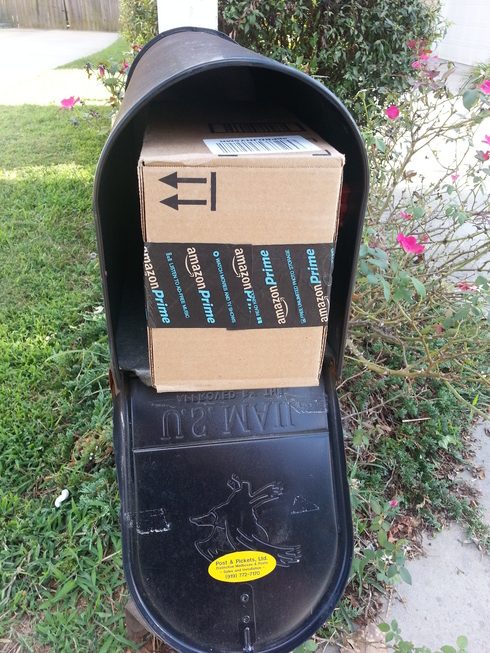
It's nice when your server fits in your mailbox.

It’s nice when your server fits in your mailbox.


I’ve always liked to have a home server hanging around for things like email, file sharing, and the like. Over the years this has taken the form of a beefy desktop computer, a PowerPC-based MacMini, an embedded Linux-based router, and recently a beat-up old laptop. All had their challenges, power consumption and fan noise being the two main ones, though the PowerPC machine and the router also couldn’t run all the software I needed. I was limping along on my busted laptop for as long as I could but decided it was nearing the end of its useful life. It was time to go shopping for something that would last me a while.

The embedded idea still appealed to me for the two main reasons I mentioned above: power consumption and noise. I wanted something that sips electricity and was quiet yet still provided enough computing power to do what I needed. After reading up on some online reviews, I went with the Intel NUC.

Intel’s NUC (“Next Unit of Computing”) systems are embedded x86_64 machines which are about half the size of a brick. They have plenty of ports: HDMI, USB 3.0, and even a Thunderbolt port. They come with your choice of Intel processors, whether it is an i3, i5, or i7 series. Memory can be boosted to 32 GB and it accepts newer SSD drives. Some models can fit 2.5″ laptop drives as well. The hardest part about making the jump to an Intel NUC was simply deciphering which Intel model had which options. Sometimes having too many choices isn’t a good thing, I suppose.
Continue reading

Insider reveals true intent of Florida’s proposed solar amendment | Miami Herald

Solar panels

Solar panels


Who’s ready to fire their electric company? A Duke Energy-backed lobbying group is pushing Amendment 1 in Florida, an anti-solar constitutional amendment disguised as a pro-solar one. This makes me wish I had some other choice for electric power than Duke Energy. Thanks to electric monopolies I don’t have that choice.

It’s time to end electric monopolies and open this market to competition. It’s time the Duke Energys in this country stop just pretending to support free markets and actually do it.

The policy director of a think tank hired by Florida’s largest electric utilities admitted at a conference this month what opponents have claimed for months: The industry attempted to deceive voters into supporting restrictions on the expansion of solar by shrouding Amendment 1 as a pro-solar amendment.

Sal Nuzzo, a vice president at the James Madison Institute in Tallahassee, detailed the strategy used by the state’s largest utilities to create and finance Amendment 1 at the State Energy/Environment Leadership Summit in Nashville on Oct. 2.

Nuzzo called the amendment, which has received more than $21 million in utility industry financing, “an incredibly savvy maneuver” that “would completely negate anything they (pro-solar interests) would try to do either legislatively or constitutionally down the road,” according to an audio recording of the event supplied to the Herald/Times.

Source: Insider reveals true intent of Florida’s proposed solar amendment | Miami Herald

Georgetown Hospital blocks MT.Net, gives Facebook a pass

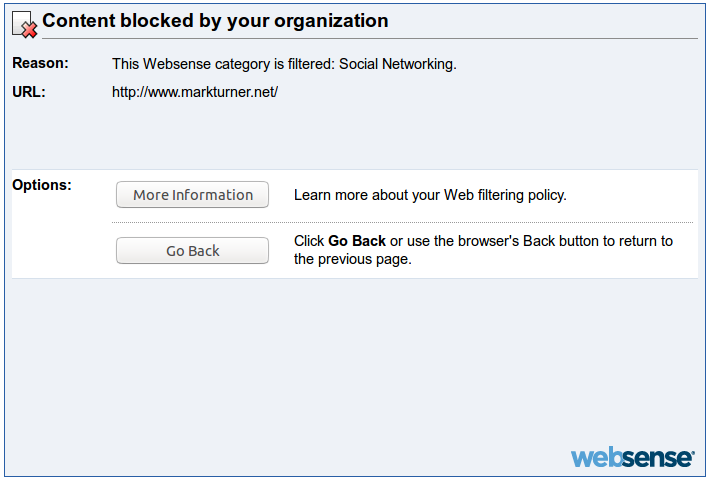
I’m connected to Georgetown University Hospital’s MedStarGuest network and trying to keep from being bored between tests. I was about to do some blogging this morning when I was greeted with a WebSense notification that my blog has been blocked:

No MT.Net for you!

No MT.Net for you!

What makes this particularly amusing is that Facebook is not blocked by the hospital’s WebSense nanny filter. It seems that MarkTurner.Net is considered “Social Networking” but Facebook, the granddaddy of all social networking sites, is not blocked for being “Social Networking.” What’s even more amusing is that other sites I host on the very same site using the very same software (like LigonPTA.com) are not blocked. Somehow I’ve earned inclusion onto WebSense’s no-no list.

This is yet another example of how idiotic these Internet nanny filters can be. Attention fellow IT people: there is no substitution for monitoring your own network. Don’t delegate your network monitoring to stupid products like WebSense.

And aren’t “guest” networks supposed to be safe for guests? Protect your important infrastructure with a secure network but your visitors shouldn’t need nanny filters.

Fortunately my VPN has not been blocked so that I could bring you this important message.