In real life, in the natural course of conversation, it is not uncommon to talk about a person you may know. You meet someone and say, “I’m from Sarasota,” and they say, “Oh, I have a grandparent in Sarasota,” and they tell you where they live and their name, and you may or may not recognize them.
You might assume Facebook’s friend recommendations would work the same way: You tell the social network who you are, and it tells you who you might know in the online world. But Facebook’s machinery operates on a scale far beyond normal human interactions. And the results of its People You May Know algorithm are anything but obvious. In the months I’ve been writing about PYMK, as Facebook calls it, I’ve heard more than a hundred bewildering anecdotes:
- A man who years ago donated sperm to a couple, secretly, so they could have a child—only to have Facebook recommend the child as a person he should know. He still knows the couple but is not friends with them on Facebook.
- A social worker whose client called her by her nickname on their second visit, because she’d shown up in his People You May Know, despite their not having exchanged contact information.
- A woman whose father left her family when she was six years old—and saw his then-mistress suggested to her as a Facebook friend 40 years later.
- An attorney who wrote: “I deleted Facebook after it recommended as PYMK a man who was defense counsel on one of my cases. We had only communicated through my work email, which is not connected to my Facebook, which convinced me Facebook was scanning my work email.”
Connections like these seem inexplicable if you assume Facebook only knows what you’ve told it about yourself. They’re less mysterious if you know about the other file Facebook keeps on you—one that you can’t see or control.

New “Quad9” DNS service blocks malicious domains for everyone | Ars Technica
The Global Cyber Alliance (GCA)—an organization founded by law enforcement and research organizations to help reduce cyber-crime—has partnered with IBM and Packet Clearing House to launch a free public Domain Name Service system. That system is intended to block domains associated with botnets, phishing attacks, and other malicious Internet hosts—primarily targeted at organizations that don’t run their own DNS blacklisting and whitelisting services. Called Quad9 (after the 9.9.9.9 Internet Protocol address the service has obtained), the service works like any other public DNS server (such as Google’s), except that it won’t return name resolutions for sites that are identified via threat feeds the service aggregates daily.
“Anyone anywhere can use it,” said Phil Rettinger, GCA’s president and chief operating officer, in an interview with Ars. The service, he says, will be “privacy sensitive,” with no logging of the addresses making DNS requests—”we will keep only [rough] geolocation data,” he said, for the purposes of tracking the spread of requests associated with particular malicious domains. “We’re anonymizing the data, sacrificing on the side of privacy.”
Source: New “Quad9” DNS service blocks malicious domains for everyone | Ars Technica
3 Major Reasons Why More Millennials Are Starting Blogs
“… sale of advertising can be a real moneymaker.”
Bwahahahahahaha! #unlikely
Millennials see opportunities through blogging. If they gather a solid following, the sale of advertising can be a real moneymaker, and there are a number of millennial bloggers who have successfully monetized their blogs through a number of techniques.
As an example, consider the recent phenomenon of millennial “mommy blogs.” These are smart, educated women who are now at home with children. Blogging is an outlet for them as well as a quick entryway into making a sizeable income. Many of these women spend a year or two building a following. Then, they move into monetizing their blogs and even developing their own product lines, with a loyal and trusting target audience already at their fingertips. Some of the more successful mommy bloggers have achieved incomes as high as $20,000 a month.
Source: 3 Major Reasons Why More Millennials Are Starting Blogs
America’s global influence has dwindled under Donald Trump – Endangered
Many people find reassurance in the sober, capable military men who surround him (see article). His chief of staff, his defence secretary and his national security adviser all understand the horrors of war and will stop him from doing anything rash, the argument goes. Optimists even speculate that he might emulate Ronald Reagan, by shaking up the diplomatic establishment, restoring America’s military muscle and projecting such strength abroad that a frightened, overstretched North Korea will crumble like the Soviet Union. Others confidently predict that even if he causes short-term damage to America’s standing in the world, Mr Trump will be voted out in 2020 and things will return to normal.
All this is wishful thinking.
Source: America’s global influence has dwindled under Donald Trump – Endangered
Paradise Papers: Tax haven secrets of ultra-rich exposed – BBC News
A huge new leak of financial documents has revealed how the powerful and ultra-wealthy, including the Queen’s private estate, secretly invest vast amounts of cash in offshore tax havens.
Donald Trump’s commerce secretary is shown to have a stake in a firm dealing with Russians sanctioned by the US.The leak, dubbed the Paradise Papers, contains 13.4m documents, mostly from one leading firm in offshore finance.BBC Panorama is part of nearly 100 media groups investigating the papers.
As with last year’s Panama Papers leak, the documents were obtained by the German newspaper Süddeutsche Zeitung, which called in the International Consortium of Investigative Journalists (ICIJ) to oversee the investigation. The Guardian is also among the organisations investigating the documents.
Sunday’s revelations form only a small part of a week of disclosures that will expose the tax and financial affairs of some of the hundreds of people and companies named in the data, some with strong UK connections.
Many of the stories focus on how politicians, multinationals, celebrities and high-net-worth individuals use complex structures of trusts, foundations and shell companies to protect their cash from tax officials or hide their dealings behind a veil of secrecy.
Source: Paradise Papers: Tax haven secrets of ultra-rich exposed – BBC News
Slipping into Southern again
Yesterday morning my Southern accent got noticed again, this time by a fellow Southerner. My dentist’s office is full of good ol’ Southerners and I always love hearing the conversations going on. I was getting my teeth cleaned by a hygienist I don’t ordinarily see and she was making small talk to get to know me.
Halfway through she says, “so, where are you from? I noticed you have an accent.”
If I could’ve smiled with a mouthful of fluoride brush and suction tube, I would’ve! I don’t always remember to speak Southern until I’m around others who are speaking that way, but then I just slip back into it without me even noticing. I suppose if I were around more places where Southern was spoken i would speak it more often, too, but Southern isn’t spoken much in Raleigh anymore.
Hallie’s story runs on the front page of the N&O
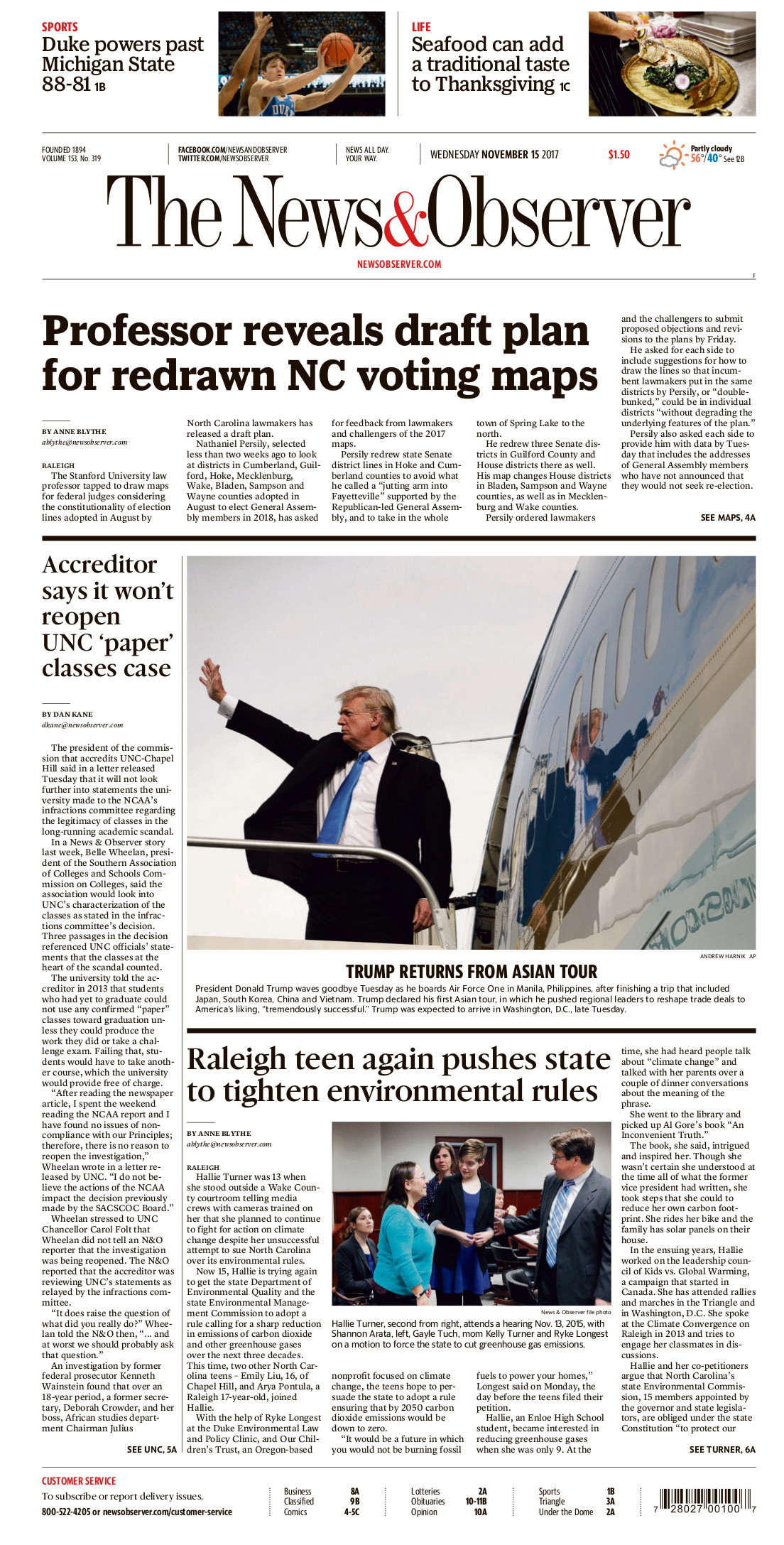
The story of the new environmental lawsuit that Hallie is participating in (along with two other teens) ran on the front page of the News and Observer today. Pretty cool to see that.
This is at least the second time she’s been featured on the N&O’s front page, if not the third. The first time was when she was still a guest of the WakeMed NICU.
Rowland, the astrophotographer
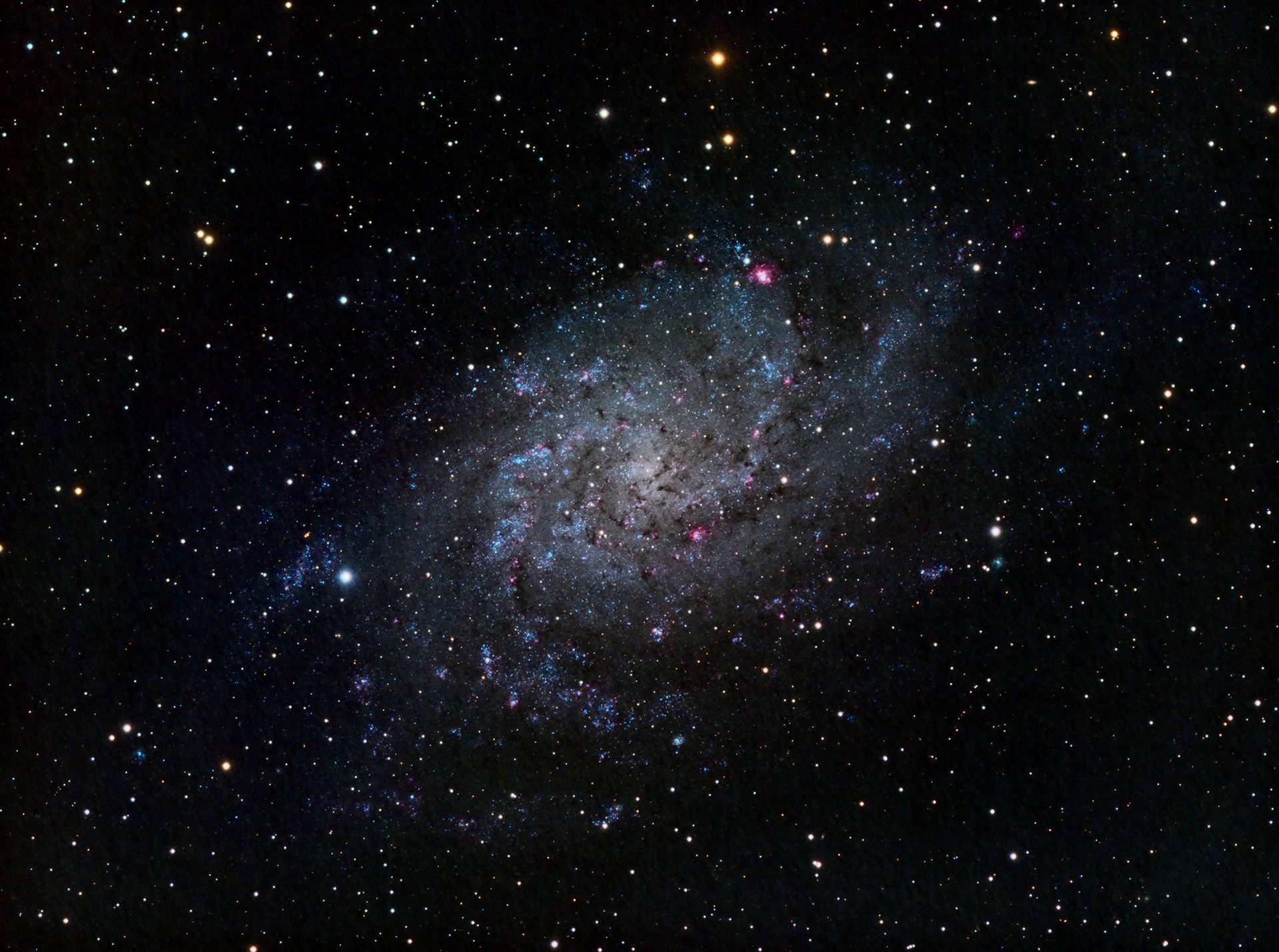
My friend and former boss Rowland Archer has a hobby of astrophotography. He’s built up quite a collection of stunning photographs that he’s taken from the little observatory he’s build in his backyard outside of Durham. Here’s one of the latest photos he’s shared, of the Milky Way’s nearest neighboring galaxy, Messier 33.
Says Rowland:
This is Messier 33, the Triangulum Galaxy, so named because it is in the constellation Triangulum and was the 33th object discovered by Charles Messier – who was a comet hunter and famously compiled a list of “darn, another fuzzy thing that’s not a comet!” Ironically, his list of stuff to avoid is now one of the most popular list of things to observe! M33 is part of the local group of galaxies – it’s smaller than our Milky Way, and fainter than the Andromeda Galaxy posted earlier this week, but I think it’s a rocking looking galaxy from our view here on Earth – the blue spiral arms, the red knots of color in the arms that are active star forming regions, and the individual stars visible in both. It’s about 3 million light years away from us, and contains “only” about 30 billion stars. But it’s still the third largest member of our local group – our neighborhood of galaxies that are close enough to be bound together by gravity.
Amazing stuff!
John Oliver on what we’ve learned from a year of Trump presidency
This segment is great stuff.
Grandma’s house is for sale again
One of the great things about the way real estate is sold on the Internet is being able to get a virtual tour of the homes you knew and loved. I found out that my grandmother’s former home at 937 Oak Avenue in Panama City, FL is now for sale (MLS# 663442). Poking through the photographs it appears the owners (who bought it from Grandma’s estate) didn’t change it as radically as they could’ve. The most drastic changes are the paint colors. Apparently the electrical system has been upgraded. I don’t recall the renovated rear bathroom but that might have been there at the time Grandma lived there. The kitchen hasn’t changed basically at all, which was good to see.
I created a copy of the Zillow page here, as the house is pending sale and the listing won’t be available much longer. I also have photos from that page that I will add to the blog.
I hope I can take another walk (perhaps my last?) through it when we’re down there for Thanksgiving.